- Friedrich Nietzsche,
Miscellaneous Maxims and Opinions
The Second Facet evolved around a memory from Chardath's childhood. It appears to depict one of the first times the young lord witnessed the debauchery of the gambling and other "entertainments" his mother offered at Castle Spulzeer to line the family coffers. Travelers who explore this facet see the darker side of life, one in which everything appears evil and threatening. All the fear and apprehension that the young Chardath felt before he embraced this dissipated existence falls upon the heroes.
Physically, this place looks like a great gambling hall. Though the heroes simply appear in the middle of the room after their journey through the conduit, no one takes note of their arrival.
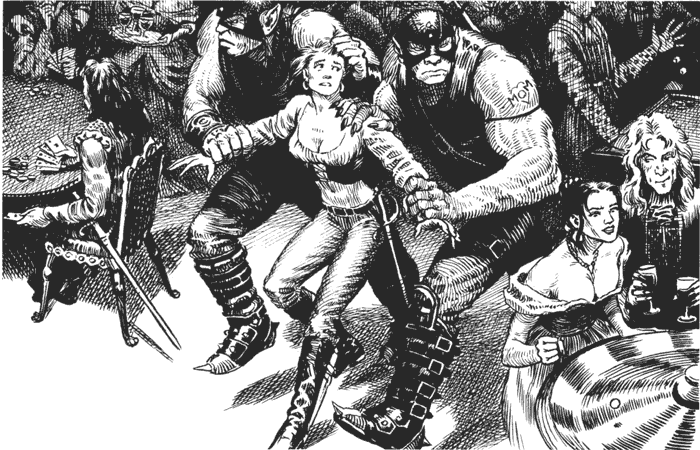
As the characters mill about, they find any number of activities, ranging from roulette wheels and dice tables to card games and tests of skill. The reflections who inhabit this facet are exaggerated representations of the folk who commonly frequent such places. These include lascivious women, violent men, and all manner of real and imagined dangers.
The following narrative can be read aloud to the players when their characters first arrive in the Second Facet:
You stand in the midst of what appears to be a targe gambling hall. Thick pillars rise out of a smooth stone floor to support a white plaster ceiling. Dozens of elegant crystal chandeliers, each worth a small fortune, spread bright light to every comer of the place. Everything else is an expanse of brightly polished wood, glittering metal, and gleaming glass.
A great press of people moves to and fro, seeming to divide their attention between games of chance and the dazzling array of refreshments being offered by wandering servers. The clatter of dice, the ringing of coins, and the shouts of success and failure fill the air with a deafening storm of disorienting sounds.
Although the gambling hall is huge-several hundred feet across-it is not boundless. Anyone who takes the time to explore the dimensions of the room discovers that it is pentagonal, with each side measuring some seven hundred fifty feet in length.
At the center of each wall is a door made of dark wood. Beyond each of these portals is a conduit. Details of how to open the doors and leave this facet appear at the end of this section.
Despite its appearance, this place is not a normal casino, but rather the impression of such a place through the eyes of a child. As such, there are a number of bizarre twists that become apparent as the characters look around.
Shortly after one of the heroes decides to begin gambling or exploring the casino, Maleffluent contacts the party again. Details of his message appear toward the end of this section.
Mood and Athmosphere
The gambling hall, like all the facets of Aggarath, is not a real world. Rather, it is a composite of the impressions that Chardath had as a child of the casino that his mother operated within the walls of Castle Spulzeer.
Crowds: The Dungeon Master can play up the strange nature of this place by emphasizing certain aspects. The most obvious of these is the crush of people in the hall. Every movement the heroes make should be described in terms that require them to "push through the press of bodies" or "force your way through a knot of people." There is no privacy in the Second Facet, something that can quickly get on the adventurers' nerves.
Chaos: The Second Facet is never still or quiet, but a constant sea of noise and chaos. The rumble of background conversation is like the continuous roar of surf on a rocky coast. Glasses clink together, chips rattle on tables, dice clatter to a stop, and dealers or croupiers constantly call out odds, card values, and the like.
A creative Dungeon Master can make this an important part of exploring the gambling hall by forbidding the players to speak in hushed tones. This reflects the fact that their characters cannot whisper to each other in so noisy a place.
Distortions: All of the nonplayer characters encountered in the Second Facet are reflections.
As such, they are drawn from Chardath's memories more than from the real world. Their nature is not apparent at the start of the encounter, but it grows more pronounced with the passage of time.
For example, a courtesan encountering one of the heroes might be presented as beautiful and graceful woman when first met. Over the course of the game, she might become more and more wanton and slovenly. In the end, she evolves into a predatory harlot.
Patrons: The myriad people who fill the Second Facet are automatons whose only purpose for existence is to give life to this gambling hall. They cannot be persuaded, either with or without force, to break this pattern. They are interested only in gambling and carousing.
On the same note, the enforcers are programmed only to break heads and keep order in the gambling hall. They can be defeated or driven off for a time, but more of them will appear almost at once.
Should the heroes opt to play a game of chance, they are more than welcome to do so. As long as they have coins to toss on the table, the dealers and croupiers are glad to serve them. Credit is not accepted at the gambling tables of Castle Spulzeer.
Adventurers can find any number of entertainments offered here. The most popular three are described in some detail below. Dungeon Masters may also wish to introduce other, more familiar, games of chance.
It is essential that the Dungeon Master keep in mind one very important fact while refereeing this part of the adventure. Put simply, there is no way that the heroes are going to win any money at these tables. The games are all rigged against them. As a child, Chardath was well aware that the odds were always in the house's favor. He did not understand that this was a subtle thing, however, and assumed that everybody lost their money all the time.
Cards: The game of cards played here is called "Three Card Run." In order to play, a character need only seat himself at a table and ante-up one gold piece. Each table has five players and one dealer. A posted sign indicates that a winning hand pays off with odds of 50 to 1. Clearly, a little luck can win a lot of money at this table.
In order to resolve this game, the Dungeon Master should use a normal deck of playing cards. Other types of cards can be used as well, like the Tarokka deck from earlier Ravenloft game products or even the Fate Deck from the Dragonlance: Fifth Age game.
The rules to Three Card Run are quite simple and very unfair. The object of the game is to end up holding three cards which are in sequence. In a standard deck of playing cards, with aces being low, this might be a two, three, and four, for example. Runs do not wrap around, so a collection of king, ace, and two is not a winning hand.
The game begins with the dealing of a single card face-up to each player. At that point, a player may either drop out or stay in the game. Staying in the game requires the betting of an additional gold piece.
Once these second bets have been placed, those who remain in the game are dealt a second card. At this point, the same choice is offered to them: Drop out or bet a gold piece to stay in the game. Since only three cards are dealt in this game, anyone whose cards are more than one number apart has no real choice but to drop.
Lastly, a third card is dealt to anyone who remains in the game. At this point, any character who holds three sequential cards has a winning hand.
At least, that is how it worked in the real world. In the domain of Aggarath, things run a little bit differently.
No matter what cards the character has, the dealer will always find some flaw in the hand. For example, he might note that the run consists of two black cards and a red one. As such, it is a loser. Of course, the reverse (two reds and a black) would also be true. Similarly, a hand with three sequential cards of the same suit would be disqualified because it lacks diversity.
There is no such thing as a winning hand at this table (or any of the others, for that matter).
Dice: The most common game of dice in the gambling hall, "Double Up" is played with an ordinary pair of twelve-sided dice. These dice must be of two different colors, normally red and black.
Double Up is played at a circular table with five gamblers (known as casters) gathered around. A posted sign indicates a payoff of 10 to 1. While these odds are not as good as the payoff for a game of Three Card Run, they still promise a quick profit-if there were any chance of winning, which there is not.
To begin a game of Double Up, a character must pay a fee of five gold pieces to "buy in". This means that he has purchased the chance become a caster, or dice roller. As soon as there are three casters at the table, the game can begin.
Play proceeds counter-clockwise. The caster to the croupier's right tosses his dice. The value on each die is noted and announced by the croupier (for example, "red seven, black ten").
After this is done, the next caster (to the first player's right) does the same. When all the casters have thrown their dice, the croupier examines them for winning rolls.
In order to win at Double Up, a player must exactly match the roll of the caster to his left. For the last caster, this means matching the roll of the first caster. Thus, the roll of "red seven, black ten" is a winner only if the person to that player's left also throws a "red seven, black ten." Clearly, a winning throw is difficult enough in Double Up even if the game is not rigged.
If a character should manage to win, the croupier announces that the total of his two dice and those of the caster to his left is an automatic loss. In our "red seven, black ten" example, this means a thirty-four (7+10+7+10).
The Wheel: Playing the wheel is very much like playing roulette. This particular game is called Moonstone, in honor of the glowing sphere that it is played with. The posted odds for a game of Moonstone are 50 to 1.
The wheel itself is a five-foot disc with depressions in it numbered from one to one hundred. The majority of even-numbered depressions are colored white while most odd- numbered ones are colored black. Depressions numbered in multiples of five, whether odd or even, are colored silver; the number 100 is plated in gleaming gold. The wheel's ebony handle is adorned with an almond-shaped ruby. A betting table with spaces matching the colors and numbers on the wheel stands to the side.
As many as ten people can play Moonstone at a time. Each places a bet of not less than one gold piece on a particular space on the table. There is a space for each number on the wheel and a player can bet on up to five numbers at a time.
Once all the bets are down, the croupier spins the wheel and drops the glowing ball onto it. It takes roughly a minute for the wheel to come to a stop and the moonstone to settle into one of the depressions.
The outcome of the spin can be determined by rolling 3d 10. Two of the dice indicate the number generated by the spin of the wheel. The third has no real purpose, but the Dungeon Master should not tell the players that. Care should be taken to make this roll with dice which are of the same color. In that way, the Dungeon Master can read them any way he wishes to make certain that the characters lose their bets. For example, a roll of 1, 2, and 7 can be read as 12, 17, 21, 27, 71, or 72. The Dungeon Master will almost always be able to select a number which was not chosen by one of the players.
Once the wheel comes to a stop, the croupier examines the table and pays off any winning bets. (Surprise-there aren't any!)
If the unthinkable happens and every possible combination of numbers is a winner, the croupier points out that spin was not valid. "Someone has interfered with the wheel," he will announce. As soon as he says this, a trio of enforcers shows up and grabs one of the gamblers (a nonplayer character). Although he struggles, he is dragged away and quickly vanishes in the crowd. As soon as this commotion dies down, the croupier spins the wheel again.
If another winning roll comes up, the croupier makes another excuse. No matter how many times the heroes believe that they have won, something makes that particular spin of the wheel invalid.
The Enchanted Ruby
The almond-shaped gem set into the handle of the Moonstone wheel is one of the rubies that can help the characters escape from Aggarath. Of course, they have to find a way of getting the stone without upsetting the enforcers who patrol the hall.
Enforcers
A number of large, burly men patrol the Second Facet. The heroes do not notice these brutes at first, although the reverse may not be true. These enforcers are reflections of the guards who kept order in the gambling halls of Castle Spulzeer.
Any time the heroes cause a commotion, they attract the attention of the enforcers. The Dungeon Master determines exactly what sort of actions might qualify; however, any violence or threat of violence will bring a squad of enforcers.
In the real world, the enforcers were normal men. In the eyes of a young Chardath, however, they were hulking brutes. As such, the following description can be read to the players when they first set eyes on the enforcers:
Without warning, a giant of a man suddenly emerges from the milling crowd. His face is brutish and primitive, gray with stubble and almost lost beneath a thick, overhanging brow. He wears bright, almost festive clothing, but dark, ruddy splashes stain it. Whether these spots are wine or something more sinister s impossible to say.
As he moves closer, you notice a heavy wodden cudgel in his hand. Like his clothes, this weapon is darkly stained.
The enforcers strike without warning, attempting to subdue the troublemakers with as little fuss as possible. They do this by raining blows with their cudgels upon the characters.
The game statistics for these brutes are as follows:
Enforcers (3 per character): AC 10; MV 9; HD 1+2; hp 8; THACO 19; #AT 1; Dmg 1d6 (cudgel); SA stun; SD regenerate; SZ M (6' 7" tall); ML steady (12); Int low (6); AL LE; XP 65.As soon as a character loses consciousness (either through an enforcer's stun attack or loss of hit points) an enforcer picks him up, drags the body to the nearest door, and hurls him out. "Escaping the Facet," at the end of this section, details this method of exiting the Second Facet.Notes: SA-On a natural attack roll of 20, an enforcer delivers a potential knockout blow to his target. If the victim fails a save vs. paralysis, he is instantly knocked unconscious for 1d10 rounds. SD- Enforcers can regenerate 3 hp per round, even after death. Only the complete annihilation of the body (via disintegration, for instance) destroys them forever.
Personality: brutal, primitive.
Note that gamblers near any battle with the enforcers pay no attention to it. The sea of humanity parts so that they do not interfere with the battle, but that marks the extent of their notice.
Socializing
Another vivid aspect of Chardath's memory of this time and place are the wanton women and lecherous men who frequented Castle Spulzeer. Such folk, commonly identified with gambling halls and similar places, are certainly not lacking here. They are, however, magnified into the terrifying things that a young Chardath believed them to be.
Any hero who sets out to find companionship or otherwise socialize with the press of people filling the Second Facet has no trouble doing so. Within five minutes he attracts the attention of a harlot or similar person.
Conversation: If the hero seeks only conversation, he has no problem. While he manages to obtain no useful information, the character probably does not get into any trouble. The only things that these reflections can talk about is the casino, gambling, and similar things. They have no lives outside of this facet and are utterly unable to answer questions or carry on a conversation about another subject.
For example, a question such as, "Where do you go when you leave this place?" is answered with a comment like, "Leave? Oh, I can't leave now, the Moonstone wheel is paying off today!" This type of conversation can prove frustrating at the very least for the heroes.
Romance: If romance with a member of the gambling hall crowd is the adventurer's objective, things go far worse. Chardath well remembers being told that "men and women like that are pure poison!" As a young boy, he took this quite literally.
For ease of reference, such characters are called "courtesans" here, whether they are male or female. Note that these characters have the same game statistics as the ermordenung described in the Ravenloft MonstrousXcompendium Appendices I & II.
Courtesan (1): AC 10; MV 15; HD 4; hp 25; THACO 17; #AT 1; Dmg nil or ld2 (fist); SA poison touch, poison embrace, poison kiss; SD immune to poisons; SZ M (5' 8" tall); ML champion (15); Int very (11); AL LE; XP 650.An encounter with a courtesan begins casually enough. The character finds his would-be companion playful, flirtatious, and very charming. The intent of the courtesan soon turns more forward, however, as the reflection tries to lure the character into an embrace and then a deadly kiss.Notes: Poison Touch - The courtesan's touch is deadly. A successful attack roll requires the target to save vs. poison with a +4 bonus or fall dead instantly. A successful save means the victim suffers 10 points of damage. Poison Embrace - Should the courtesan lure a foe into an embrace, the victim must roll an unmodified save vs. poison. Failure indicates death; success results in the loss of 20 hit points. Breaking free of the embrace requires a save vs. paralysis. Male courtesans have Str 18/90, females 18/50; stronger heroes receive a +4 bonus on their roll to break to the embrace, weaker characters a -4 penalty. Poison Kiss - If the courtesan kisses a victim on the lips, he must save vs. poison at a -4 penalty. Failure indicates death; success indicates the loss of 30 hit points.
At no time do any of the casino's patrons pay any attention to the encounter between a character and a courtesan. Cries for help and the like are ignored. Remember, none of these people is anything but an automaton doing what Chardath's memory dictates that they do.
If violence erupts during a character's encounter with a courtesan, enforcers arrive. Almost as soon as they appear, the courtesan vanishes. Following that, the enforcers beat the character senseless and throw him out of the gambling hall.
Rogues
A giant gambling hall like this might appear to be a potential treasure trove for rogue characters. There are pockets to pick, card games to rig, and piles of gold coins waiting to be stolen.
Things are not as they appear, however.
Any attempt to steal coins or cheat at a game of chance succeeds. (This is the only way in which one of the characters can win money at one of these games). Less than 1d6 rounds later, however, a squad of enforcers arrives to confront the characters.
These brutes are not satisfied with simply beating up the rogue and throwing him out of the gambling hall. Once the victim is subdued, they strip him of all his possessions (including his clothes!) and haul him to one of the doors in preparation for his departure.
Just before the character is thrown through the door, however, one of the enforcers produces a primitive syringe full of green liquid from a pouch on his belt and injects it into the rogue's arm. The Dungeon Master should instruct the player to make a saving throw vs. poison for his character.
The chemical (or its reflection in the gemstone universe) was designed by a friend of Chardath's mother for use in situations like this. It has the effect of gradually transforming the victim into a snake creature similar to a yuan-ti (as described in the Monstrous Manual tome). As a child, Chardath was always told that thieves are nothing more than snakes! He took this statement literally, and his memory now makes it true.
The transformation takes 1d4 weeks and is very gradual. Each day, the Dungeon Master should present the character with a new and progressively more apparent change. In the end, the character will be utterly inhuman.
A transformed character has the same class abilities that he did as a demihuman and does not gain the yuan-ti's psionic or magical powers. He does experience a loss of 4 points from his Strength score, but gains 2 points of Dexterity. His Charisma is halved. His movement rate becomes that of a yuan-ti (12, slither 9). The character's new reptilian skin gives him a base Armor Class of 8.
High-level curative spells such as heal can halt the transformation. Reversing the process once it is complete requires a powerful spell like wish or polymorph.
Maleffluent
At some point during their time in the Second Facet, the characters are contacted again by Maleffluent. He offers them a bit of information about this place and the history of Chardath's family. In addition, he gives them a hint about the location of the enchanted ruby in this facet, trying to direct them toward the glowing moonstone.
The following narrative is Maleffluent's message to the party. As before, the Dungeon Master should read it aloud in a shallow, hoarse voice to make it sound ethereal and supernatural.
"You stand in a place of vice and avarice, the source of my matser wealth. Pay no heed to the glitter of gold, for it can do us no good in this realm. Serach instead for the light to find that which will aid our escape."
Five doors stand spaced around the walls of the gambling hall. Beyond these doors lie the conduits that link this facet to others.
Like the monoliths in the first facet, the doors are identical to each other. It might be possible for the players to tell one from the other by noting the various gambling tables near each door. Dungeon Masters should not suggest this, however. It should be allowed only if the players think to ask.
At first, getting through these doors does not seem an easy task. No magic or other effort of the player characters enables them to open one.
The reflections who inhabit this place can open them easily, however. In order to open a door, a hero need only ask a passing reflection to do so. If the character has his hands full or otherwise looks like he can use some help, he should have no problem. However, if he makes no effort to look like he needs help, the reflection tells him to open the door himself.
Alternatively, a character can get himself beaten up by the enforcers and thrown out of the casino. The biggest problem with this plan is that enforcers toss subdued heroes out the nearest door-which might result in scattering the party to different facets. Of course, if a character who is not involved in the fray follows along, he can catch the door and hold it open. In this way, all of the party members can escape through the same door.
The following table indicates the facets to which these conduits lead. The Dungeon Master should designate one door as "number one" and label the rest clockwise.
| Door Number |
Destination Facet |
|
| 1 | 1 | |
| 2 | 10 | |
| 3 | 7 | |
| 4 | 8 | |
| 5 | 4 |
